


From 1 November 2026, the whole of York will become a Smoke Control Area to help improve air quality and protect people's health.
At the moment, around 80 per cent of York households are already covered by a Smoke Control Area
Expanding it across the whole city will make the rules easier to understand and help cut harmful smoke from solid fuel burning. Smoke from open fires and stoves is one of the main sources of tiny air pollution particles known as PM2.5.
These particles are so small that they can enter the lungs and bloodstream and affect people's health.
The change is not a ban on wood-burning stoves or open fires. Residents can continue to use them if they follow the rules.
From 1 November:
Prolonged smoke from chimneys attached to buildings will not be allowed for more than 15 minutes after initially lighting a fire
- Open fires must use authorised smokeless fuel
- Wood can still be burned in a DEFRA-approved stove
- Wood should be dry and properly seasoned
- Residents should look for the "Ready to Burn" logo when buying wood fuel.
The new rules do not apply to outdoor barbecues, chimineas, garden fire pits or bonfires, which are covered by separate legislation.
The council's first priority will be helping residents understand the changes and how to follow them. However, people who repeatedly break the rules following advice, could face a fine of up to £300.
Councillor Jenny Kent, Executive Member for Environment and Climate Emergency, said:
"From 1 November, the same smoke control rules will apply across the whole of York. This change will help improve air quality and support better health for everyone in our city.
"This is not about saying people can’t use stoves or open fires. It is about helping people use the right fuel in the right way, so we can all benefit from cleaner air."
Peter Roderick, Director of Public Health for York, said:
“Solid fuel burning accounts for nearly a third of PM2.5 emissions in York. There are no safe levels of these particles - they harm everyone, especially children and older people. Expanding the Smoke Control Area is a proportionate, evidence-based step to protect health and reduce preventable deaths.”
Residents can find out more about the changes, check whether their stove is approved and learn which fuels can be used on our website
The council recognises that many residents use solid fuel heating as part of keeping their homes warm during winter. The new rules do not ban stoves or open fires and residents can continue to use them if they burn the correct fuel in the correct appliance.
Advice and support on energy efficiency and home heating is available through York Energy Advice, YorEnergy and the council's Home Energy Efficiency Team.
York's Smoke Control Area will cover the whole City of York Council area from 1 November 2026.
Information leaflets are available in libraries across the city.
Support is available through York Energy Advice, YorEnergy and the council's Home Energy Efficiency Team.
Additional background
The following comments were included in communications when the expansion was approved and are provided as background information:
Dr Caroline Everett, Respiratory Consultant at York and Scarborough Teaching Hospitals NHS Foundation Trust, said:
"Many respiratory conditions, including asthma and COPD, can be worsened by poor air quality. PM2.5 particles from wood smoke can travel deep into the lungs and bloodstream and have been linked to serious health problems.
"Cleaner air helps protect everyone, particularly children, older people and those living with respiratory conditions."
Charlotte Freeman, on behalf of Parents for Future York, said:
“Wood burning can make homes cosy and warm, but it's also the most polluting way to heat our homes. Particles which are too small to see, known as PM 2.5 are emitted, which then enter our lungs, blood stream and other organs.
"Air pollution adversely impacts human health throughout the life course. But children are particularly vulnerable, because exposure to air pollution during gestation, infancy, childhood, and adolescence affects developing organs, and increases the risk of chronic disease in adulthood.
“Expanding the Smoke Control Area is a step in the right direction, to reduce the inhalation of air pollution. This won't mean people can't use log burners anymore, but instead, must check that the correct fuel is being used, in the correct way.”
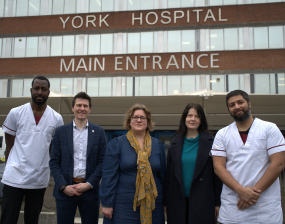
Photo caption left to right:
Calvin - Respiratory Clinical Scientist
Peter Roderick - Director of Public Health at City of York Council
Dr Caroline Everett - Consultant Respiratory Physician
Cllr Jenny Kent - Executive Member for Environment and Climate Emergency
Muhammad, Lead Clinical Respiratory Scientist